
Price Events Since 1970
- Monday, March 22, 2004
This analysis featured in the March 22, 2004 issue of the HGCA's MI Prospect, Volume 6, Number 19
Key points
- World price events usually short term
- Supply response can come quickly
- UK sheltered by EU policy until recently
- World stock environment low
The 40 percent rise in UK cereal prices during the second half of 2003 was unexpected but welcome to many growers. This article reviews similar international price events over the last 30 years with a view to providing some perspective on the current situation.
In the past when international grain prices have risen significantly, they have usually peaked with an often immediate and sometimes abrupt fall off (graph 1). The reason for this is that higher prices tend to encourage increased output and that consumption has with some important exceptions been stifled by higher prices. There has generally been the capacity to increase output relatively quickly and usually within a 12-months. In contrast when prices fall they tend to bottom with an often delayed recovery.
continue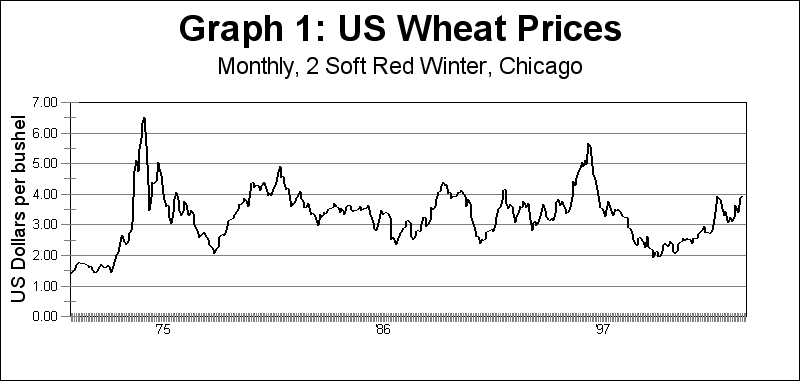 Source: USDA
continued
Unlike international wheat prices, UK prices have until relatively recently tended to reflect EU CAP support mechanisms, with seasonal price increases reflecting monthly increments in intervention prices (graph 2).
continue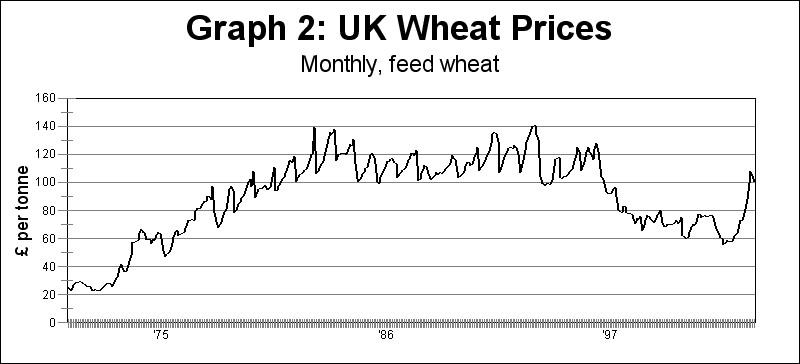 Source: HGCA
continued
International Price Events
The most significant price event was without doubt in the mid 1970's. It was unique in that it lasted for more than two years, starting in mid 1972 lasting through until 1975. Furthermore, prices did not fall back to earlier levels after the rise. 1972 was the year when the Soviet Union made its first major grain purchase on world markets. This was not due to a particularly poor crop but by a political decisionto increase food consumption in the Soviet Union, and hence import grain as required to meet the planned consumption.
Between 1971 and 1973 Soviet grain consumption increased by almost 20 percent, 30 million tonnes. It was not surprising that the world was not able to meet this kind of instant demand. In1975, when the Soviet Union did have a crop disaster. They imported almost 26 million tonnes, considerably more than it did in 1972/73. By then, however, global production had increased sufficiently to meet this demand, even allowing for an increase in year end stocks.
After this there were three minor price events. The 1979/80 surge in prices was again the result of Soviet buying. The Soviets had a poor crop in 1979 and a series of only fair crops for several years, thereafter, necessitated further increases in imports. By then the capacity to meet this demand had been developed. In 1984 the Soviet Union imported 55million tonnes, more than 23 percent of total world grain trade without any major impact on international prices.
A very poor US maize crop in 1988 together with continued high levels of imports by the Soviet Union and China resulted in a significant tightening of the global grain balance. As a result prices were buoyant for the duration of the 1988/89 and into the 1989/90 crop year.
Although the global grain supply situation does not in retrospect appear to have been particularly tight 1991/92, it was the last year of major grain imports by the Soviet Union and China, more than 60 million tonnes between them, and the First Gulf War was in progress causing no doubt some nervousness. US wheat prices rose by more than 40 percent during the second half of 1991 but fell by almost as much in first half of 1992.
The 1995/96 price event followed five years during which world production was generally relatively stable but consumption continued to increase. A tightening global grain balance with some recovery in Chinese buying coincided with poor US spring grain crops. Prices began to advance as soon as it became apparent that the 1995 US spring crops were going to yield poorly. The price advance generally held until late summer the next year. By then a record world grain crop appeared likely and some easing in supply demand balance seemed assured.
UK Price Events
The impact of world grain prices on the UK market are in retrospect not so obvious. The UK joined the European Economic Community in 1973 and the surge in world prices in the 1970's probably lifted UK prices to the European level. But by 1975 the intervention mechanisms of the CAP were in place to support UK prices above world levels.
The next time that world prices rose sufficiently to have a material impact was in 1995/96. This occurred just as the MacSharry Reform and its sharp reductions in intervention support was being implemented. This price event simply deferred the decline in EU prices to the lower support level.
The surge in UK prices in 2003 was the result of poor crops across much of the FSU and southern Europe at a time when EU intervention stocks were virtually exhausted. Currency events also contributed to the eraly rise in UK prices. The strong prices mirrored therefore not the sharp price rises on international markets as reflected in US markets.
Conclusions
What is evident from more than 30 years of history is that a single random event, such as major crop failures, may trigger, in combination with a relatively tight existing world grain balance, a major price increase for a brief period. But, the combination of the incentive to increase production and limit consumption that this creates, quickly dampens prices. It is also evident that the major, and politically rather than price motivated, imports by the Soviets and Chinese between the mid 1970's and mid 1990's had an important impact on international prices.
The 2003 advance in UK prices was the consequence of a loss of perhaps 40 million tonnes of output to drought across the length of southern Europe, together, of course, with a relatively tight global supply situation. A similar crop short fall somewhere would seem to be needed to sustain higher prices. This is not beyond the realm of possibilities but probably is beyond that of probability. Further with FSU and Chinese continue to purchase grain but more in terms of millions rather than tens of millions of tonnes.
New crop prices have held as well as they have in order to reflect the risks that remain until the 2004 crop is harvested. With a background of low global stocks, and many crops yet to eb harvested, international buyers are willing to pay more than usual to secure supplies, while farmers’ need a little bit more encouragement to sell forward for the same reason.
David Walker
phone: 01603 705153
top of page